
There is no sight in Jupiter, Florida more immediately arresting than the Jupiter Inlet Lighthouse — a 105-foot tower of red-orange brick rising above the confluence of the Loxahatchee River, the Indian River Lagoon, and the Atlantic Ocean. It has stood on this promontory since 1860, guiding mariners safely through the treacherous inlet for more than 160 years, and today it stands as one of the oldest and best-preserved lighthouses in the entire state of Florida. To visit it is to step into the very beginning of South Florida’s recorded history.
The lighthouse was designed by Lieutenant George Meade of the U.S. Army Corps of Engineers — the same George Meade who would go on to command Union forces at Gettysburg during the Civil War. Construction was a brutal undertaking. Workers battled insects, disease, and the unforgiving subtropical terrain to haul building materials through miles of wilderness. When the light finally shone for the first time on July 10, 1860, it was a triumph of engineering and human endurance against extraordinary odds.
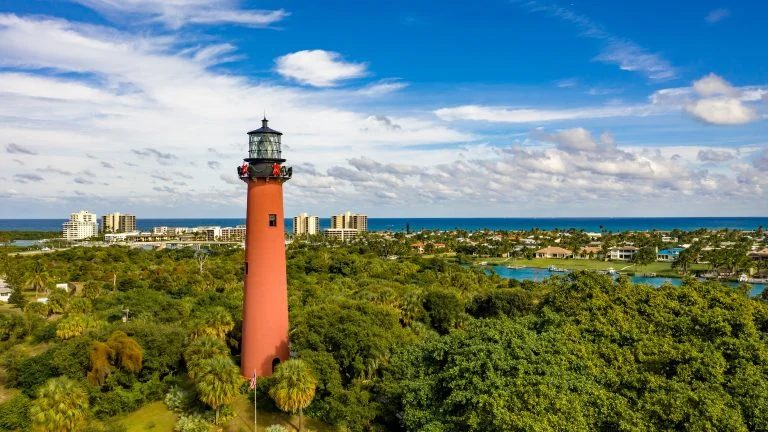
The 105-step climb to the top of the lighthouse is the centerpiece of any visit, and it rewards every ounce of effort. The spiral staircase winds upward through the brick tower with a graceful momentum, and when you step out onto the lantern gallery at the top, the view is genuinely breathtaking. To the east, the Atlantic stretches to the horizon. Below, the blue-green waters of the Jupiter Inlet shimmer in the Florida sun, and the sweep of coastline visible from the summit spans miles in every direction.
Volunteers stationed at the top bring the experience to life with stories, historical anecdotes, and a warmth that makes the visit feel deeply personal rather than merely touristic. Upon completing the climb, every visitor receives a certificate acknowledging the accomplishment — a small touch that children and adults alike tend to treasure. The staircase is narrow in places but the pace is entirely self-directed, and most visitors of any fitness level complete the ascent without difficulty.
The lighthouse itself has survived an extraordinary amount of history since its completion. It was briefly extinguished during the Civil War when Confederate sympathizers removed its Fresnel lens to prevent Union naval vessels from benefiting from its guidance. The lens was eventually recovered and reinstalled, and the lighthouse has operated almost continuously ever since — a quiet constant in a part of Florida that has changed almost beyond recognition in the surrounding decades.
The museum complex surrounding the lighthouse is as rich and rewarding as the tower itself. A short nature trail winds through the grounds past a reconstructed Seminole chickee hut, a ship’s bell salvaged from a 19th-century wreck, and the historic Tindall Pioneer Homestead — one of the oldest surviving structures in all of Palm Beach County. The grounds overlook the inlet directly, making them one of the finest places in Jupiter to spot manatees gliding through the shallows below the observation dock.
The museum exhibits inside the welcome center cover the lighthouse’s construction in meticulous detail, the lives of the keepers who tended its flame through hurricanes and wars, and the broader history of the Jupiter Inlet area from the ancient Tequesta people to the present day. The permanent collection includes original keeper’s logbooks, historical photographs, and navigational instruments that place the lighthouse within the larger story of Florida’s maritime heritage in ways that feel immediate and human.
One of the most moving aspects of any visit is the realization of how isolated this lighthouse once was. In 1860, there was virtually no surrounding community — just dense subtropical wilderness, a handful of settlers, and the constant, indifferent presence of the sea. The keepers who tended this light and their families lived lives of remarkable self-sufficiency and quiet courage, and the museum tells their individual stories with care and specificity that humanizes what could easily remain abstract history.
The Jupiter Inlet Lighthouse & Museum is open Tuesday through Sunday from 10:00 AM to 4:00 PM, and is closed on Mondays. Guided docent tours depart regularly throughout the day and are included with the price of admission. Adults pay $18, seniors $15, and students $10, with children 5 and under admitted free. Parking is available on site at 500 Captain Armour’s Way, Jupiter, FL 33469. Plan to spend at least two hours to do the experience proper justice.
The museum pairs beautifully with a visit to DuBois Park, located just minutes away at the entrance to the Jupiter Inlet, for a full afternoon on the water. Several waterfront restaurants in the surrounding area make it easy to round out the day with a memorable meal. Whether you are a history enthusiast, a lover of coastal architecture, or simply someone who wants to understand why this corner of Florida feels different from everywhere else, the Jupiter Inlet Lighthouse & Museum delivers in full — and it lingers in the memory long after you have returned home.
You’ve just discovered something special! Next up: discover the crystal-clear lagoon and free family fun at DuBois Park, just minutes from the lighthouse or head to our homepage for even more guides.
