Skip to content


LinkedIn Lead Generation Services: How to Turn Connections Into Clients
SEO
July 10, 2026
LinkedIn is the most powerful channel in B2B prospecting. With over a billion professionals active on the platform, it gives you direct access to the decision-makers who control purchasing budgets. Unlike cold email or paid social ads, a well-crafted LinkedIn connection request feels like peer outreach rather than advertising. Decision-makers are more receptive, and conversations move faster.
The challenge is consistent execution. Generating a reliable pipeline from LinkedIn requires the right profile, precise targeting, compelling messaging, and disciplined follow-up — everything that LinkedIn lead generation services are specifically built to deliver.
What LinkedIn Lead Generation Services Include
A LinkedIn lead generation service manages prospecting and outreach on your behalf, freeing your sales team to focus entirely on qualified conversations and closing. Rather than spending hours each week building lists and crafting messages, you hand that work to specialists who operate the system at scale.
Core deliverables typically include:
-
Profile optimization to build credibility and trust with your ideal buyer.
-
ICP development and precision prospect list building via Sales Navigator.
-
Personalized connection requests and multi-step follow-up sequences.
-
Reply handling, categorization, and meeting booking.
-
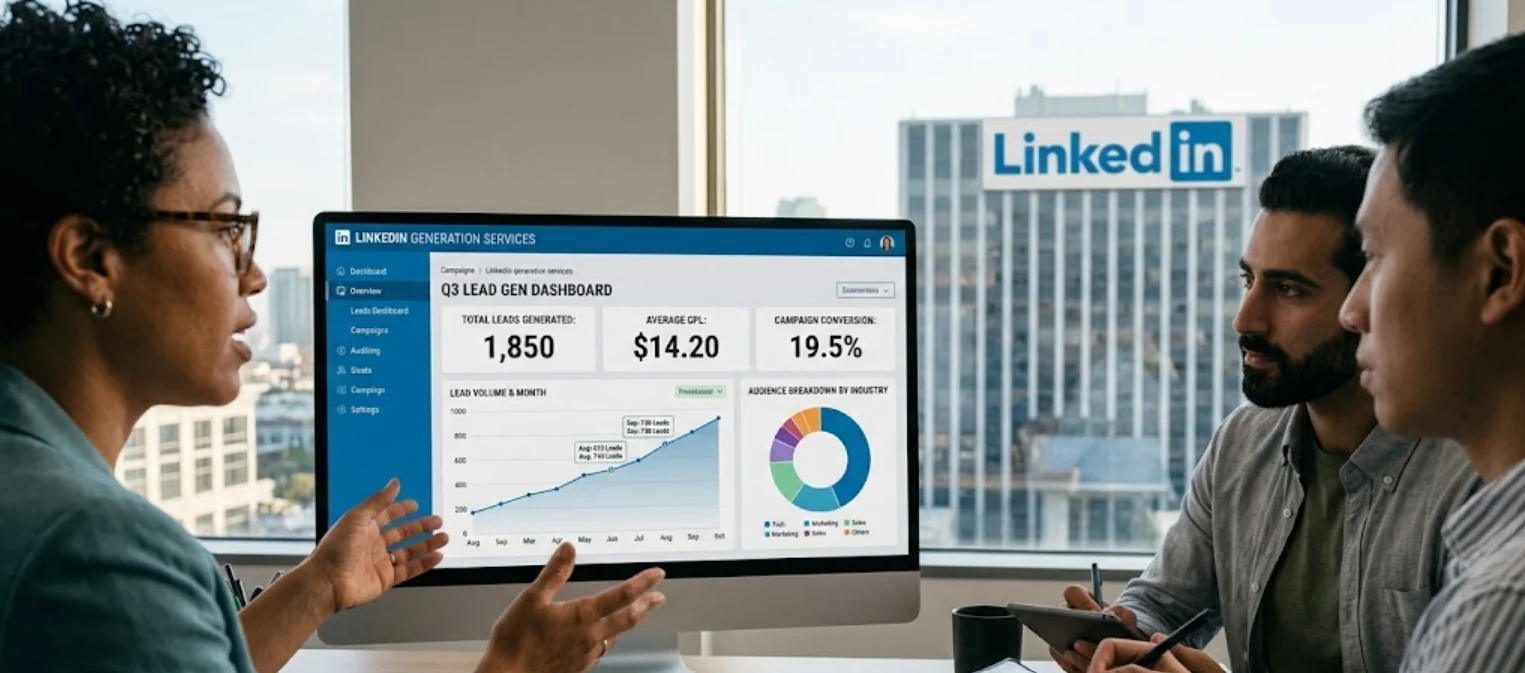
Weekly reporting on acceptance rates, replies, and meetings booked.
Higher-tier services also integrate LinkedIn content and thought leadership to warm audiences before outreach begins, consistently producing stronger response rates than cold outreach alone.
The Outreach Sequence That Generates Results
Effective LinkedIn lead generation follows a structured sequence that respects the prospect’s time while creating genuine openings for conversation:
-
A concise, personalized connection request tied to the prospect’s specific role or company situation.
-
A value-first follow-up within 48 hours of acceptance — no pitch, just relevant insight.
-
A second touchpoint five to seven days later for prospects who have not yet responded.
-
Optional: An organic warmup step, such as liking or commenting on the prospect’s content prior to sending the request.
Messaging quality is everything. Specific, low-pressure outreach consistently outperforms generic templates — especially in tight-knit industries where prospects immediately recognize copy-paste campaigns. Coordinating LinkedIn outreach with email follow-up typically lifts qualified reply rates by 30 to 50 percent compared to running either channel in isolation.
How to Evaluate a LinkedIn Lead Generation Agency
The LinkedIn lead generation market ranges from excellent to actively harmful. The wrong partner can restrict your profile, damage your brand with key prospects, and waste months of budget. Evaluate every agency against these criteria:
-
Connection acceptance benchmarks: 25 to 40 percent is achievable with good targeting; anything below 20 percent signals poor list quality or a weak profile.
-
Positive reply rate: Separate from total replies, 2 to 5 percent of connections sent is the realistic target.
-
Platform safety practices: Automation without proper limits risks permanent account restriction; ask what tools are used and how weekly invite caps are managed.
-
ICP process depth: Strong agencies identify trigger signals and persona-level buying criteria, not just industry and company size.
-
Reply handling speed: Positive responses should be flagged and routed to your team within hours, not days.
Avoid agencies that guarantee meeting numbers or use identical templates across all clients. Both are reliable indicators of poor execution and weak pipeline quality.
Agency vs. In-House: The Practical Decision
An agency gets you to first pipeline in two to four weeks with immediate expertise across targeting, messaging, and platform compliance. Building equivalent capability in-house typically takes three to five months and far greater investment once salary, tools, and ramp time are accounted for.
For many B2B companies, the best model is a hybrid: the agency handles outreach mechanics and list building while the internal team focuses on content, relationships, and deal progression. The agency runs the system; your salespeople focus on conversations that close.
Frequently Asked Questions
Q1: How many LinkedIn connection requests can be sent safely per week? Most established accounts can safely send 80 to 100 connection requests per week, spread gradually across business days rather than sent all at once. Newer or lower-activity accounts should begin at 30 to 50 per week and build upward over time. Exceeding a maximum of 100 per week raises a severe risk of account restriction—something reputable agencies actively monitor and manage by leveraging secondary tactics like Open InMails to expand reach safely.
Q2: How long before LinkedIn outreach generates pipeline? First positive replies typically arrive within two to four weeks of launching outreach. Booked meetings tend to follow within four to six weeks. Building a consistent, predictable pipeline contribution takes two to three months as the connection base grows and messaging is refined. LinkedIn also compounds over time — an established, engaged network generates more organic inbound interest than a brand-new one starting from zero.
Q3: What connection acceptance rate should I expect? Well-targeted B2B outreach to decision-makers achieves 25 to 40 percent acceptance. Highly personalized connection requests with specific context can push this to 40 to 50 percent. Conversely, generic or pitch-heavy notes typically fall to 10 to 15 percent. Profile optimization and targeting precision are both major drivers and should be addressed before any campaign launches.
Q4: Does LinkedIn work for every B2B market? LinkedIn performs strongest in technology, SaaS, financial services, and professional services where decision-makers are active platform users. It delivers weaker results for very small businesses, trade-based or industrial sectors, and markets where WhatsApp or industry-specific platforms are the dominant professional communication channel.
Q5: Can LinkedIn outreach replace cold email? For most B2B use cases, LinkedIn and cold email are more effective in combination than either alone. LinkedIn warms up email outreach; email provides a second touchpoint for LinkedIn connections who have not yet responded. Running both channels in a coordinated sequence consistently produces higher qualified reply rates than relying on a single channel.
LinkedIn lead generation, executed with the right strategy and the right partner, delivers some of the highest ROI available in B2B marketing today. The platform gives you direct access to exactly the decision-makers your business needs to reach — and results depend entirely on the quality of strategy and execution behind your outreach.



Your Cookie Preference
We use different types of cookies to optimize your experience on our website. Click on the categories that you want to allow. Visit our website to learn more about our Cookie Policy
These cookies are necessary for the basic functionality of the website. Without these cookies, certain functions, like live chat, knowledge base, etc., will not work.
Learn more
These cookies are used to enhance your browsing experience. Also, these cookies will aid us in assisting you better with our engagement and support tools.
Learn more
These cookies are used to help us understand how our website is being used. They can also be used to analyze the effectiveness of our marketing activities and to create a personalized browsing experience for you.
Learn more
Use Essential Only
Accept